

Technology
The Weekly Status PDF Is Lying to Your Execs
The status report your leadership reads every Monday looks precise and authoritative. Underneath, it is a hand-assembled snapshot of data that was old and uncertain before anyone typed it in.
The document leadership trusts without auditing
Somewhere in your organization, a project manager spends part of every week building a status report. They pull numbers from a schedule tool, a budget spreadsheet, a few email threads, and a couple of phone calls, format it into a clean PDF, and send it up. By Monday it is in front of leadership. Real decisions get made against it, from which market to reprioritize to where the money goes next.
The format is the trouble, because it looks authoritative. Rows line up and percentages carry a decimal, with a red-amber-green column that reads at a glance. Nothing in the layout signals how much of it was estimated or how old the inputs were, let alone how sure whoever assembled it felt.
It is old before it is opened
A hand-built report is a snapshot of a snapshot. The project manager captured each number on the day they happened to pull it, which was not the same day for every number, and not the day you read the result. A schedule that was accurate on Wednesday is stale by the Monday it reaches an executive. On a portfolio moving across dozens of active sites, a lot changes in five days. The document does not carry its own age, so the reader takes Wednesday's status for this morning's.
The numbers underneath are shakier than the format admits
Set the staleness aside, and the deeper trouble is the data feeding the report. Quickbase's Gray Work Index found that only about 10% of workers are extremely confident in the accuracy of the key project information they rely on, which leaves close to 90% carrying some doubt about the numbers they pass along. Autodesk and FMI found something blunter still, reporting that in a survey of thousands of construction professionals, 30% said more than half of their own project data is bad, by a definition that counted anything inaccurate, incomplete, inaccessible, inconsistent, or untimely.
A PDF launders that uncertainty. Data that someone would hedge about out loud becomes a firm number in a cell that reads as a green light in a boardroom.
What a live rollup does instead
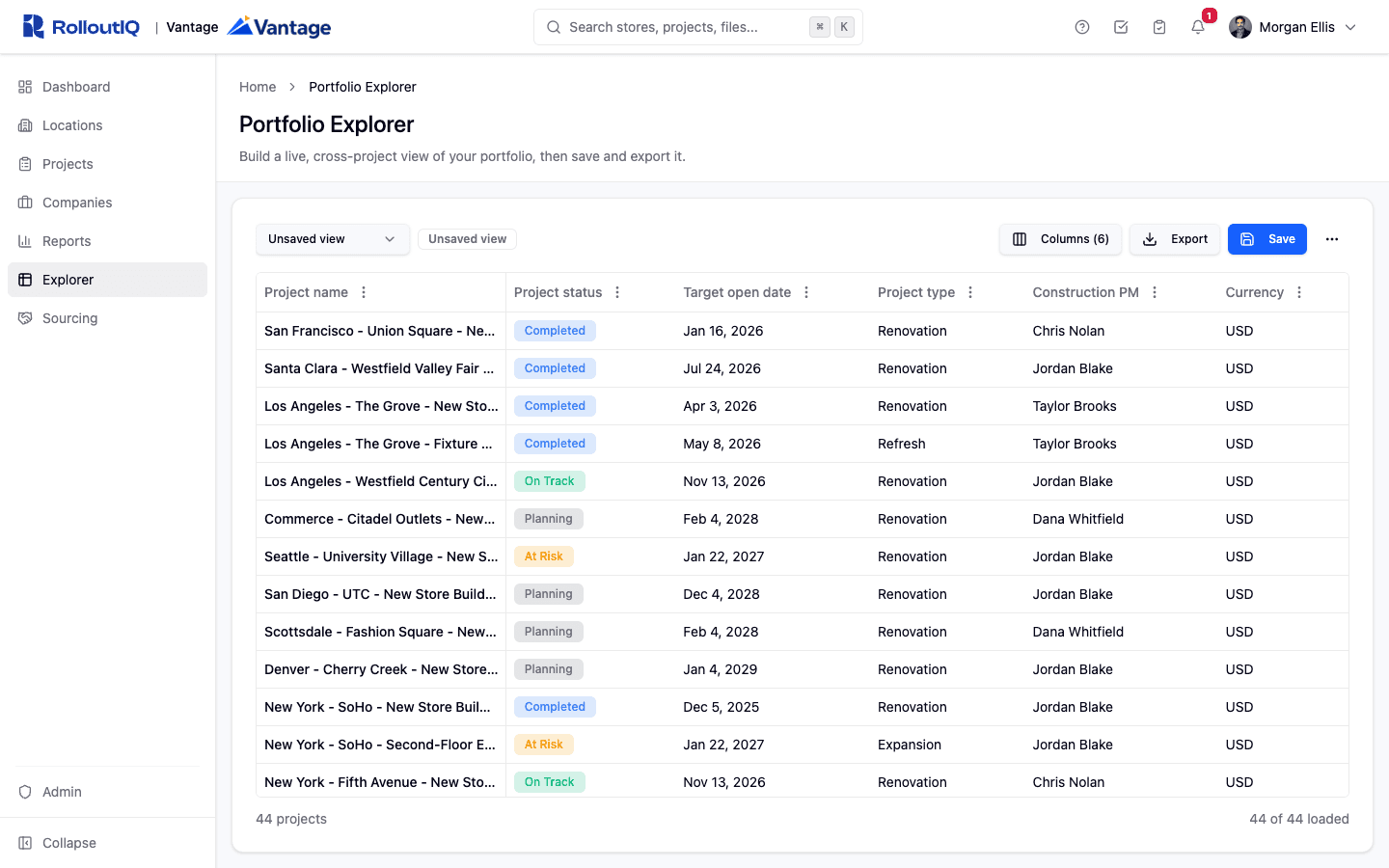
A reporting surface leadership can trust reads live. It pulls from the same records the field is updating, so there is no assembly step and no lag between what happened and what the report shows. Every number opens up, with a headline figure or chart one click from the underlying rows, so "why is that number what it is" gets answered in the tool rather than becoming a request to whoever built the deck. The surface also declines to guess where guessing would mislead, so a section that cannot load says so instead of showing a zero, a filtered report prints exactly which brands and regions it covered, and a trend it cannot honestly reconstruct is left undrawn.
RolloutIQ's reporting is built this way, and it is candid about its own boundary. The cost view reports budget movement, your approved baseline against your revised budget and the change-order exposure between them, and it states plainly that it holds no invoices or payments, so it does not report actual spend or burn rate. A report that flags the cells it could not fill spares the reader from discovering later which ones were guesses.
Reporting people keep opening
The real test of an executive report comes the first time a confident-looking number turns out to have been a guess. After that, leadership either keeps opening the report or quietly stops. A surface that reads live and admits what it cannot see earns the next open, week after week. The polished weekly PDF is assembled by hand from uncertain inputs, and each guess in it that later gets caught makes leadership trust the next one a little less.
Sources
The figures cited in this article come from the following public research.
- Quickbase, Gray Work Index - https://www.quickbase.com/news/press-releases/report-70-percent-of-workers-lose-20-hours-a-week-to-fragmented-systems
- Autodesk and FMI, Harnessing the Data Advantage in Construction (2021) - https://adsknews.autodesk.com/en/pressrelease/study-from-autodesk-and-fmi-finds-better-data-strategies-could-save-the-global-construction-industry-1-85-trillion/

Written by
Nariman Shariat
Founder, RolloutIQ
Nariman has spent about 20 years opening stores, in the seat between the landlord, the architect, and the general contractor, across some of the largest retail and workplace fleets in the country. Along the way he built the internal platform that ran store development across a fleet, then rebuilt the same idea company after company. He founded RolloutIQ to give multi-site development teams the single source of truth he kept having to build by hand, and writes here about the work of opening and remodeling stores at scale.
More about NarimanKeep Reading
Related Articles
Continue exploring best practices for store development and construction management.
Why Your Portfolio Rollup Lives in a Spreadsheet
The master tracker a leadership review runs off is usually a spreadsheet someone rebuilt by hand, and it is out of date by the time they read it. Why it happens at multisite scale, and what a live cross-project view changes.

The Single Source of Truth Is What Lets a Program Scale
Most teams read single source of truth as one system, then run a consolidation project that does not fix anything. The useful definition is narrower, and it decides whether a program survives its own growth.

Structured Data Is the Multiplier on Every AI Tool You Buy
An assistant can only answer the questions your data is shaped to answer. Structure is what turns a tool that helps a little into one that multiplies your whole stack, and it keeps paying after the model changes.

How to Think About AI in Retail Construction: Data First, Agents Second
Every construction platform is announcing AI features. The operators who win in the next cycle will not be the ones who bought the most AI features. They will be the ones who made their construction data agent-ready.
Ready to Build Smarter?
See how RolloutIQ™ can streamline your retail and multi-site rollout program. Book a personalized demo with our team.