
Construction Management
Finding the Real Critical Path When 40 Store Schedules Share One Crew
A rollout can carry a correct construction schedule for every store and still open late, because each schedule assumes its contractor's crews are free. With superintendents and electricians hard to hire in 2026, that assumption is an expensive one to carry.
Every store schedule assumes its crew is free
Each store in a fall class of 40 has a construction schedule built from the program template, its dependencies wired the way the prototype gets built and its critical path running from permit issue to turnover, and the math on any one of them holds up.
A class that size might be split across six general contractors and one national fixture installer, and no individual schedule records any of that. Store 12 has electrical rough-in starting the week of October 5 with eight days of float. Two towns over, store 19 shows the same week, and both schedules are counting on an electrical sub who can be in only one of those buildings at a time.
Jerome Wiest named the flaw in 1964, in the journal Operations Research: the critical path method and PERT, he wrote, "implicitly assume that unlimited resources are available," and once resources are limited the usual ideas of critical path and slack "lose their normal meaning." Retail programs that schedule each store as its own project are still working from that assumption more than 60 years later.
Where the critical path goes when crews are shared
Wiest's point was that a job can be held up by a missing resource as surely as by the job in front of it. When two stores need the same superintendent in the same week, one of them waits without the wait appearing on either Gantt chart. His answer was a resource-aware "critical sequence" of jobs. Eliyahu Goldratt's 1997 book Critical Chain carried a similar idea to a much wider audience, defining the longest chain of work linked by both task order and shared resources.
A rollout opens stores at the pace of its scarcest shared crew, whatever the individual schedules say. The program's real critical path threads through that crew store after store, and in critical-chain language the shared superintendent or install team is the drum the whole class keeps time to. Hand a GC six concurrent starts in October when it can field four superintendents, and two of those stores have no superintendent on the dates their schedules show.
The conflict lives between projects. It shows up only when every store's dates for the same scope sit next to each other, and leveling one project file at a time cannot find it.
The 2026 labor market, read from a store development seat
Superintendents set a general contractor's ceiling on concurrent stores. Trades can be subbed out, but every active job needs a super, and supers are hard to hire this year. In the AGC and NCCER 2026 Workforce Survey, 75% of the 476 firms with superintendent openings reported difficulty filling them, rising to 77% among building contractors, the segment closest to retail and restaurant work. Electricians were harder still: 81% of the 103 firms with electrician openings said the same.
Data centers are one reason. "The need for people to work on new data centers is keeping labor conditions tight," AGC chief economist Ken Simonson said when the survey came out. Associated Builders and Contractors reported that roughly one in six of its members was under contract on a data center in August 2026, and those firms carried 9.9 months of backlog against 8.3 months for contractors without data center work. A tenant improvement for a small-format store is a short job, and it is bidding for the same electricians.
Construction job openings stood at 251,000 in August 2026, up from 213,000 a year earlier, according to preliminary Bureau of Labor Statistics figures released September 29, while the hiring rate dipped to 3.7% from 4.1%. With openings up while hires fall, contractors look to be holding on to the people they have and posting for the roles they still cannot fill.
Laying every store's construction window side by side
The check fits in an afternoon. List every store in the class with its GC, market, construction start, and turnover date, then count week by week how many active stores each GC is carrying. Hold that count against the superintendents the GC has named to the program. Any week where active stores outnumber supers has at least one store whose dates depend on a superintendent the GC has not got.
Run the same count for the vendors a program buys nationally, fixture installers and kitchen equipment setters especially. Their benches tend to be small, and two installs booked for the same Tuesday in different states is already a conflict.
In RolloutIQ, an Analytics grid (used by your internal team, not contractors) lays the class out as one row per project. Add a Start and an End date column for whichever deliverables mark construction start and turnover in your schedule, filter to a region, group by market, and the overlapping windows line up in a grid you can share as a Report or export to Excel. Spotting the collision is as far as the software goes. RolloutIQ does not level resources or track how many crews a contractor has free, so deciding which start moves stays with the program team.
For that decision, each store's own schedule shows how much room it has. The Slack column gives the number of days a deliverable can slip before it pushes the opening date. It is computed one store at a time and knows nothing about the crew, and it is still the quickest way to find the store that can take a later start without moving its opening.
Sequencing the class around the constraint
Once the shared constraint has a name, most of the fixes come down to order and timing.
- Stagger construction starts by GC and market so no superintendent carries more stores than the GC committed to. The class opens over a longer stretch, on dates the crews can hit.
- Hold the buffer in the handoff from one store to the next, where a slip at the first site gets absorbed before the crew reaches the second. Padding added inside each task tends to get spent by the task.
- Re-baseline as actuals come in. Testing critical chain scheduling in the Journal of Operations Management in 2001, Willy Herroelen and Roel Leus found that regularly updating the baseline schedule and the critical chain gave the best intermediate estimates of final project duration, which argues for redrawing the stagger every few weeks as stores finish early or late.
- Use overtime for a week or two at most. The Business Roundtable's study of scheduled overtime found productivity on 50-hour weeks fell about 10% early on and about 30% after 12 straight weeks. Later researchers questioned the precision of those figures, so read them for direction.
- Award spring work with the superintendent count in hand. Ask each GC which supers it will put on the program and how many stores each one will carry, and build the start dates from the answer.
The October version of the problem
This month is when the squeeze is tightest. Fall classes are racing to turn stores over before the holidays, which puts the programs in a region onto the same October crews, and an electrician who loses a week on one store carries that week into every store behind it in the sequence. A program that built its stagger around superintendent counts can already see which openings are exposed.
Spring is the better place to change the habit. ABC's August reading put its members' average backlog at 8.5 months, so the GCs bidding spring work are filling the first half of their year right now, and the conversation about how many supers they can commit belongs in the bid and the award, before the first spring start date is set.
Sources
The research and labor data cited in this article come from the following sources.
- Jerome D. Wiest, "Some Properties of Schedules for Large Projects with Limited Resources," Operations Research 12(3) (1964) - https://doi.org/10.1287/opre.12.3.395
- Eliyahu M. Goldratt, Critical Chain, North River Press (1997), book
- Associated General Contractors of America, 2026 Workforce Survey release (September 3, 2026) - https://www.agc.org/news/2026/09/03/construction-workforce-shortages-remain-acute-despite-soft-market-conditions-data-centers-strain
- AGC and NCCER, 2026 Workforce Survey, national results (2026) - https://www.agc.org/sites/default/files/users/user21902/2026%20AGC%20WFS%20NCCER%20(3).pdf
- AGC and NCCER, 2026 Workforce Survey, building construction results (2026) - https://www.agc.org/sites/default/files/users/user21902/2026%20AGC%20WFS%20Building%20Construction2.pdf
- Associated Builders and Contractors, Construction Backlog Indicator, August 2026 (released September 15, 2026) - https://www.abc.org/News-Media/News-Releases/abc-survey-1-in-6-members-perform-data-center-work-backlog-rebounds-in-august
- U.S. Bureau of Labor Statistics, Job Openings and Labor Turnover Survey, August 2026 (released September 29, 2026) - https://www.bls.gov/news.release/archives/jolts_09292026.htm
- Willy Herroelen and Roel Leus, "On the merits and pitfalls of critical chain scheduling," Journal of Operations Management (2001) - https://doi.org/10.1016/S0272-6963(01)00054-7
- The Business Roundtable, Scheduled Overtime Effect on Construction Projects (Report C-2, 1980), via the Construction Industry Institute - https://www.construction-institute.org/effects-of-scheduled-overtime-on-labor-productivity-a-quantitative-analysis
The Rollout
The Rollout, in your inbox
A founder's read on retail and multi-site store development. What the latest news means for your pipeline, and what we are building, every couple of weeks.

Written by
Nariman Shariat
Founder, RolloutIQ
Nariman has spent about 20 years opening stores, in the seat between the landlord, the architect, and the general contractor, across some of the largest retail and workplace fleets in the country. Along the way he built the internal platform that ran store development across a fleet, then rebuilt the same idea company after company. He founded RolloutIQ to give multi-site development teams the single source of truth he kept having to build by hand, and writes here about the work of opening and remodeling stores at scale.
More about NarimanKeep Reading
Related Articles
Continue exploring best practices for store development and construction management.

Construction Schedule Float and How Multisite Operators Should Use It
Schedule float is one of the most useful and most misused concepts in construction management. Here is how multisite operators should think about it.
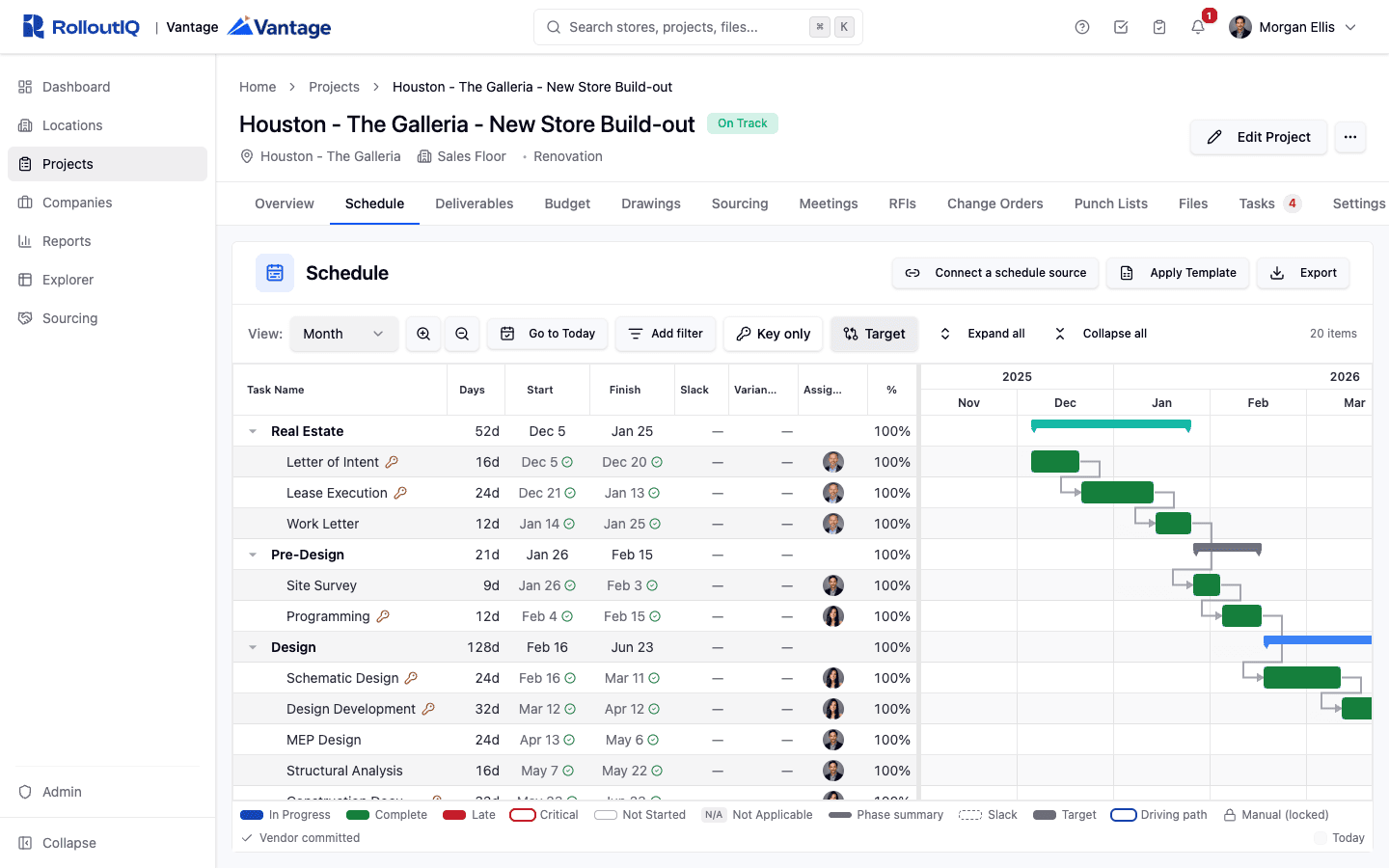
Scheduling a Retail Rollout Is a Team Sport
The schedule the whole team depends on usually lives in a file most of the team cannot open. Here is the case for one shared, role-scoped schedule that internal staff and outside partners work together.
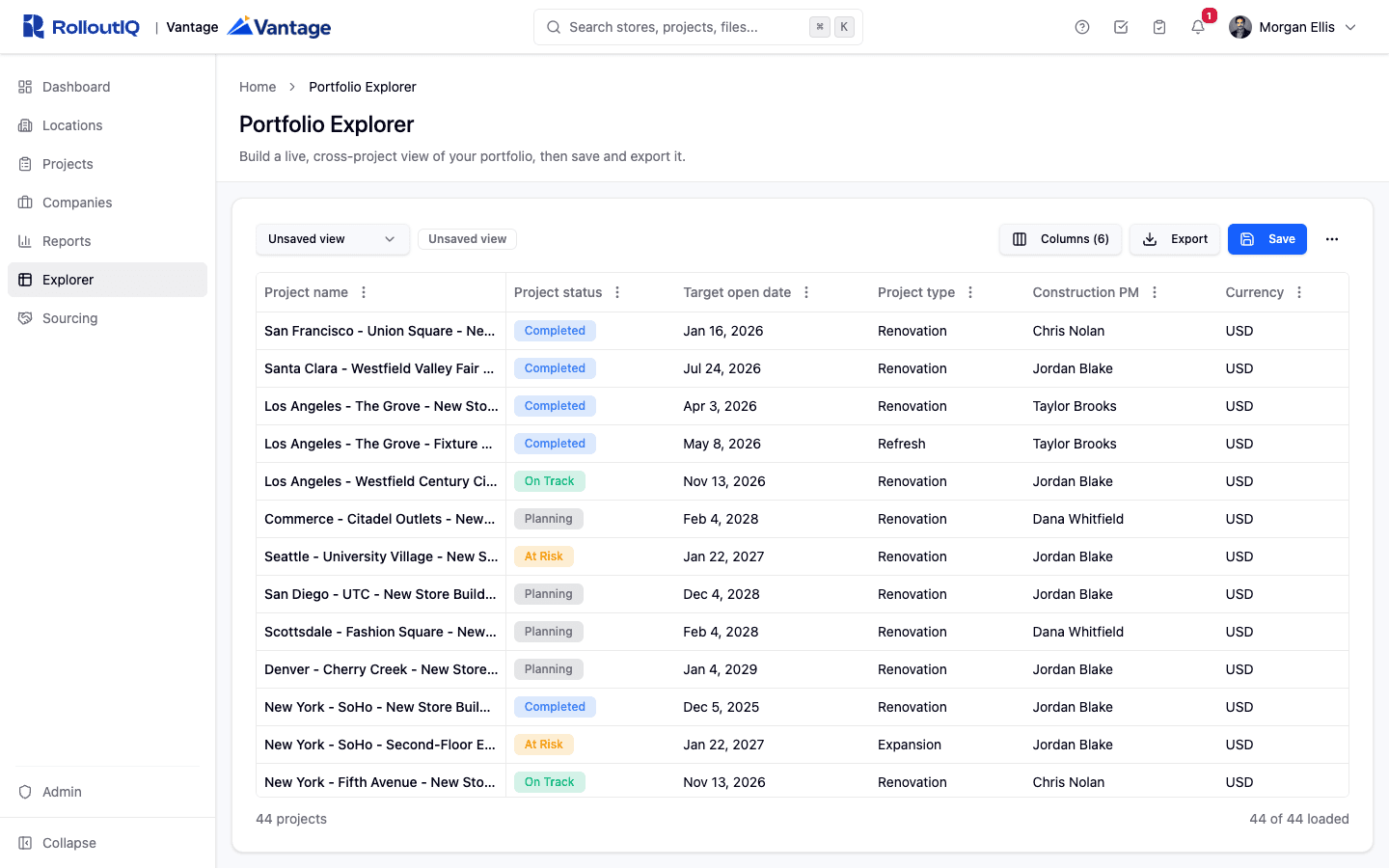
Why Your Portfolio Rollup Lives in a Spreadsheet
The master tracker a leadership review runs off is usually a spreadsheet someone rebuilt by hand, and it is out of date by the time they read it. Why it happens at multisite scale, and what a live cross-project view changes.
Ready to Build Smarter?
See how RolloutIQ™ can streamline your retail and multi-site rollout program. Book a personalized demo with our team.