

Store Development
Building a 2027 Store-Development Budget That Holds Up All Year
A 2027 store budget set this fall is set months before most large chains publish their 2027 guidance. What this year's capex filings and cost indexes say about the assumptions worth carrying, and how to keep the approved number honest once the year starts moving.
What the capex guides say heading into 2027
Costco already has a fiscal 2027 number on file. Its annual report, filed October 7, says the company intends to spend about $7.5 billion in fiscal 2027, after $6.4 billion in fiscal 2026, and plans to open up to 33 new warehouses, five of them relocations. Most large chains publish their next-year guide in February or March, so a store-development team setting its 2027 budget this fall is working from this year's guidance and its own pipeline.
This year's guidance has already moved, in both directions. Walmart raised its capex guide for fiscal 2027 (its year ending January 31, 2027) from about 3.5% of net sales to about 4.0% when it reported its second quarter in August. A month earlier, Albertsons trimmed its fiscal 2026 range from $2.0 to $2.2 billion down to $1.9 to $2.0 billion, pointing to soft unit trends and a more cautious consumer.
Guidance and spend are also two different numbers. Target guided its 2025 capex at $4 billion to $5 billion and spent about $3.7 billion. A guide is the envelope a company expects to work inside, and a store budget built on one should be labeled that way.
Remodel money and new-store money behave differently
For many large retailers, most store capital now goes into stores that already exist. In the first half of Walmart's fiscal 2027, Walmart US spent about $3.6 billion on store and club remodels and about $1.1 billion on new stores and clubs, a line that also includes expansions and relocations. Chipotle, still in growth mode, leans the other way: its 2026 plan puts about $532 million into new restaurants and about $267 million into existing ones.
The split shapes the budget template. A remodel is an occupied store, often worked at night, with concealed conditions nobody can price until the ceiling comes down, while a ground-up opening carries the site work and permitting risk a remodel rarely sees. A single template sized for one of them will misprice the other, and the error only shows up project by project, long after the annual number was approved.
Unit costs can rise while the envelope holds
Texas Roadhouse is a clean public example. Its annual report expects a 2026 restaurant to cost about $8.9 million, up from $8.3 million in 2025, "primarily due to higher rent and building costs," while the company plans total capex of about $400 million. When the per-store cost climbs and the total stays put, something inside the plan has to give, either the number of stores or the scope of each one, and the reserve held for surprises is often the easiest money to take.
That trade is better made on purpose in November. Fixing the store count means carrying a realistic unit cost. If the dollar total is what leadership will not move, the conversation turns to which projects slip to 2028.
Give escalation its own line
Finished-building costs rose 4.45% in the year to July, according to Rider Levett Bucknall's third-quarter North America cost report, and Mortenson's index put nonresidential building costs up 5.6% over 12 months. Materials are running hotter. The Associated General Contractors of America found that prices for nonresidential construction inputs rose 8.9% between August 2025 and August 2026. All three are trailing figures, so the budget has to state its own 2027 escalation assumption and the date it was priced.
Cumming's third-quarter market note told owners to carry real escalation and called the 2 to 3% line item dead, adding that an estimate priced in the spring and never re-run is light. Keeping escalation separate from contingency matters as much as the rate. AACE International's cost engineering terminology defines contingency as money for uncertain items that experience says will likely add cost, and it generally excludes escalation from that definition. A store budget that folds inflation into contingency spends its reserve on price increases before the first concealed condition turns up.
Size contingency from the risk on each project
AACE and the Royal Institution of Chartered Surveyors both reject a preset contingency percentage. The RICS cost-planning rules (NRM 1) say risk allowances "are not to be standard percentages," and ask for an assessment that accounts for how complete the design is. They also warn against letting "the natural optimism that surrounds the early stages of a building project" shape the number. AACE's estimate classification for building construction puts a Class 3 estimate, the maturity at which a budget is typically authorized, at an expected accuracy of -5% to -15% on the low side and +10% to +20% on the high side, and that is after contingency is applied.
One public owner publishes defaults. Washington State's capital budget cost-estimating form sets construction contingency at 5% for new construction and 10% for remodels. That is one state's form default, and it is useful mainly as a reminder that new work and remodels deserve different assumptions; the figure for a given store still comes from that store's risks.
By AACE's definition, contingency is expected to be spent. The U.S. Government Accountability Office's cost-estimating guide names what tends to happen to it anyway: "Unfortunately, budget cuts often target contingency funding." Tracking how much reserve each project has drawn, and how much is left across the portfolio, is what lets a team see that cut before it lands on a store already under construction.
A baseline that survives the year
A 2027 budget will be revised. Walmart's and Albertsons' guides both moved within a single year, Target spent below its range, and Texas Roadhouse's per-store cost rose while its total held. What holds up is a baseline that is approved once and then changed only through recorded revisions, so someone who was not in the room can still read it months later. A few practices carry most of the weight.
- Approve each project's budget as a dated baseline and keep that version frozen.
- Require a reason on every revision, and route it by the money it moves, so a reallocation between categories counts at its full size even when the total does not change.
- Carry escalation on its own line, tied to a dated cost index, and re-run it when the estimate is more than a quarter old.
- Size contingency per project from its risks, with separate assumptions for remodels and ground-up openings.
- Watch cumulative change on each project, because a run of small approved revisions can move a budget as far as one large one.
- Report guidance and actual spend as separate numbers, every time.
Where RolloutIQ fits
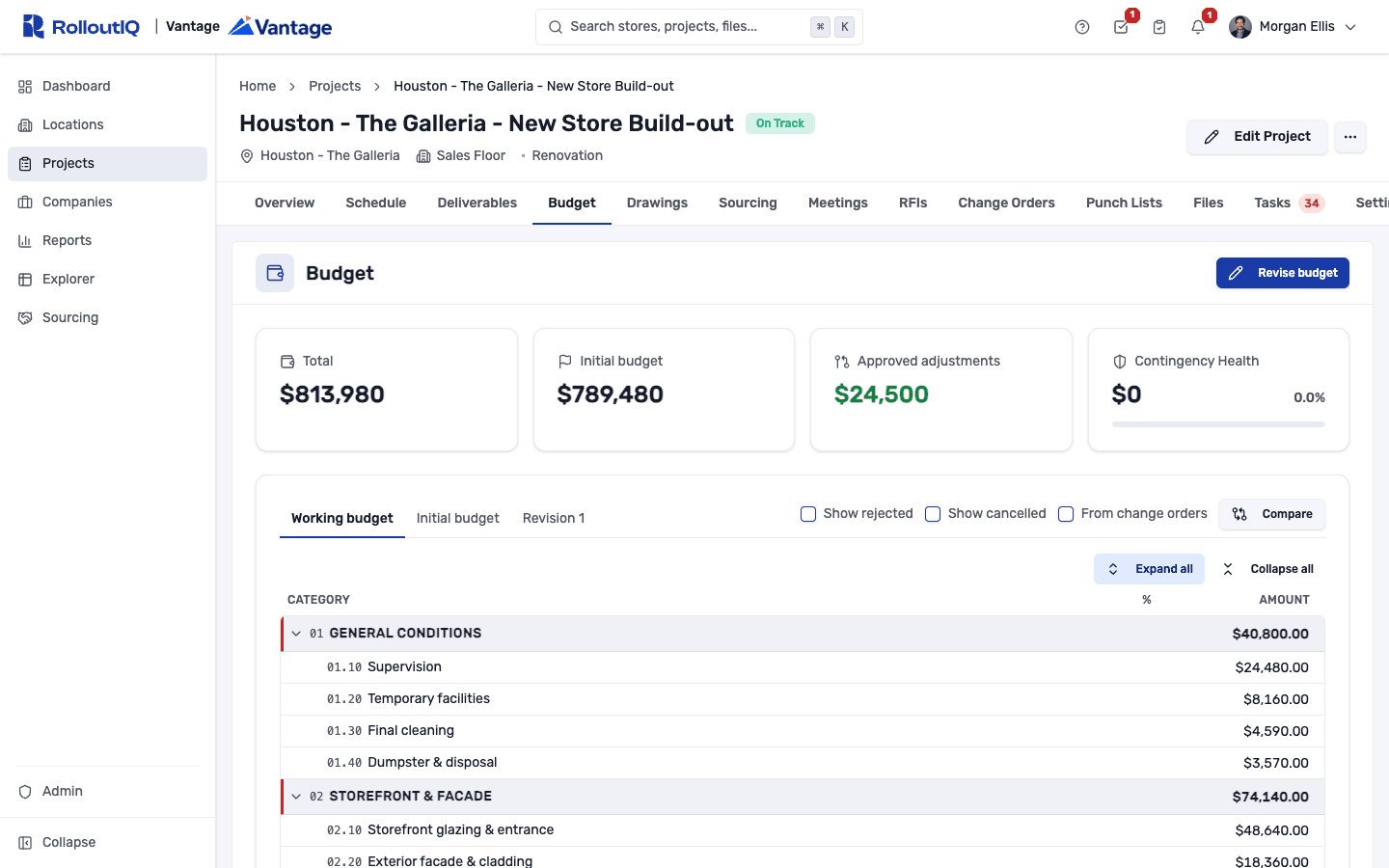
RolloutIQ's Budget covers the planned side of that list. An approved project budget freezes as a dated baseline version, and later changes are revisions with a required reason that route by the money they move, with the person who raises a revision unable to approve it. Contingency sits in reserve pools sized as a percentage of the categories they protect, with a draw-down indicator, and an optional cumulative trigger escalates approval once many small changes add up. Actual spend, commitments, and forecasts against that baseline are tracked outside Budget.
Sources
The capex figures, cost indexes, and contingency guidance cited in this article come from the following filings and publications.
- Costco Wholesale, Form 10-K for fiscal 2026 (2026) - https://www.sec.gov/Archives/edgar/data/0000909832/000090983226000093/cost-20260830.htm
- Walmart, Q2 fiscal 2027 earnings release (2026) - https://www.sec.gov/Archives/edgar/data/104169/000010416926000145/earningsreleasefy27q2.htm
- Walmart, Form 10-Q for the quarter ended July 31, 2026 (2026) - https://www.sec.gov/Archives/edgar/data/104169/000010416926000154/wmt-20260731.htm
- Albertsons Companies, Q1 fiscal 2026 earnings release (2026) - https://www.sec.gov/Archives/edgar/data/1646972/000164697226000041/aciq126earningsrelease.htm
- Target, Form 10-K for fiscal 2024 (2025) - https://www.sec.gov/Archives/edgar/data/27419/000002741925000018/tgt-20250201.htm
- Target, Q4 2025 earnings release (2026) - https://www.sec.gov/Archives/edgar/data/27419/000002741926000012/a2025q4ex-99.htm
- Chipotle Mexican Grill, Form 10-K for fiscal 2025 (2026) - https://www.sec.gov/Archives/edgar/data/1058090/000105809026000009/cmg-20251231.htm
- Texas Roadhouse, Form 10-K for fiscal 2025 (2026) - https://www.sec.gov/Archives/edgar/data/1289460/000110465926021292/txrh-20251230x10k.htm
- Rider Levett Bucknall, North America Quarterly Cost Report Q3 2026 (2026) - https://www.rlb.com/americas/insight/rlb-construction-cost-report-north-america-q3-2026/
- Mortenson, Construction Cost Index Q3 2026 (2026) - https://www.mortenson.com/news-insights/construction-cost-index-q3-2026
- Associated General Contractors of America, construction input costs, August 2025 to August 2026 (2026) - https://www.agc.org/news/2026/09/10/construction-input-costs-climb-89-between-august-2025-and-august-2026-association-survey-finds-war
- Cumming, The Two-Speed Construction Market (2026) - https://cumming-group.com/en/market-analysis/the-two-speed-construction-market-data-centers-surge-while-the-rest-slows/
- AACE International, Recommended Practice 10S-90, Cost Engineering Terminology (2026) - https://web.aacei.org/docs/default-source/rps/10s-90.pdf
- AACE International, Recommended Practice 56R-08, Cost Estimate Classification System for Building and General Construction (2020) - https://web.aacei.org/docs/default-source/toc/toc_56r-08.pdf
- RICS, NRM 1: Order of cost estimating and cost planning for capital building works, 3rd edition (2022) - https://www.rics.org/content/dam/ricsglobal/documents/standards/NRM-1_Oct2022_Update.pdf
- U.S. Government Accountability Office, Cost Estimating and Assessment Guide, GAO-20-195G (2020) - https://www.gao.gov/products/gao-20-195g
- Washington State Office of Financial Management, C-100 capital cost estimating form, 2026 supplemental (2026) - https://ofm.wa.gov/budget/state-budget-2025-27/instructions/capital/forms/
The Rollout
The Rollout, in your inbox
A founder's read on retail and multi-site store development. What the latest news means for your pipeline, and what we are building, every couple of weeks.

Written by
Nariman Shariat
Founder, RolloutIQ
Nariman has spent about 20 years opening stores, in the seat between the landlord, the architect, and the general contractor, across some of the largest retail and workplace fleets in the country. Along the way he built the internal platform that ran store development across a fleet, then rebuilt the same idea company after company. He founded RolloutIQ to give multi-site development teams the single source of truth he kept having to build by hand, and writes here about the work of opening and remodeling stores at scale.
More about NarimanKeep Reading
Related Articles
Continue exploring best practices for store development and construction management.

A Store Rollout Budget Should Be a Governed Baseline
The budget for a store project covers six cost families, not just construction, and the hard part of all of it is governance rather than arithmetic. Here is what it means to run the whole project budget as a baseline.
The Cost Code Structure That Makes a Retail Portfolio Comparable
When every project's budget is a different spreadsheet, nothing rolls up and no two stores compare. A shared chart of cost categories and families is what makes a multisite portfolio answerable to one question. What does a store cost.
Walmart's 650-Store Remodel: Why the Occupied Build Is Harder Than the New One
Walmart plans more than 650 store remodels in 2026 against about 20 new openings. The occupied remodel, rebuilt while the store keeps trading, is the harder program to run, and 2026 is full of them.
Ready to Build Smarter?
See how RolloutIQ™ can streamline your retail and multi-site rollout program. Book a personalized demo with our team.