

Store Development
New Store Opening Project Management, From Lease to Handoff
A single store opening runs for more than a year across a dozen parties. Manage it as one project anchored on the target opening date, with a named owner for every milestone.
What makes one store opening hard to manage
A single new store involves a dozen parties and one date that matters, and most of the work lives in other people's systems: the broker's deal file, the architect's drawing set, the general contractor's schedule, the IT team's install calendar, and the operations plan for hiring and training.
The lease puts a clock on all of it. Landlords typically want rent to begin, in the words of Cox, Castle & Nicholson, at "the earlier of: (1) a certain number of days (the so called 'build out period') following delivery of the premises to Tenant, and (2) the date Tenant opens for business." Once the space is delivered, the store starts costing money on a fixed date whether or not it has opened.
The runway is long, too. Texas Roadhouse's 10-K describes three to six months to locate and control a site, typically six to 12 more months to obtain permits, and then four to five months to construct, equip, and open. Over that stretch, the person who negotiated the lease may have moved on before the vendors are even hired, and decisions made at lease signing get forgotten unless someone writes them down. Keeping that runway together under one owner, from the lease through the handoff after opening, is what new store opening project management means in practice.
Anchor the project on the target opening date
Set the target opening date first and get the whole team to commit to it. It comes from the lease: the delivery date, the build-out period, any outside date for opening, and any remedy if the landlord delivers late. Read those clauses before the kickoff meeting, because they decide how much of the schedule you control.
The date also drives spending. The Cheesecake Factory's 10-K puts pre-opening costs at about $1.0 million to $1.5 million for a typical restaurant, with the largest share landing in the three months that include the opening month and the two before it. The same filing says those costs vary with unexpected delays in obtaining final licenses and permits. All of that money is committed on the assumption that the opening date holds.
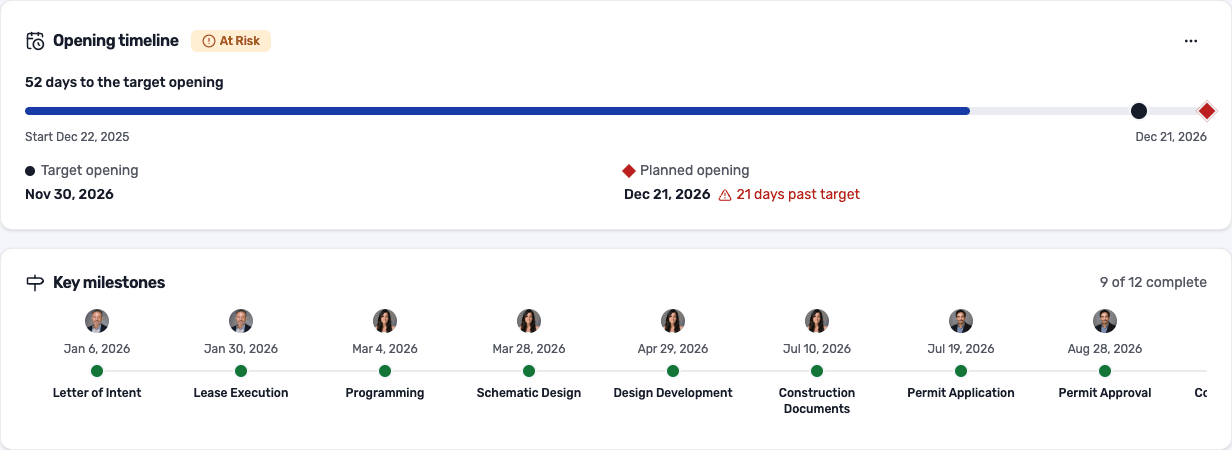
Write the date down in one place and agree who has the authority to move it, usually the head of store development, so that a revised date is a decision someone made and recorded.
Who owns each milestone
Most late openings trace back to a handoff between two parties, and when nobody owns that handoff, a week tends to go missing. Every milestone on the critical path needs one named person accountable for it, even when a vendor does the work. A workable split for a typical inline or freestanding opening:
- Lease execution and landlord delivery: the real estate manager, who also owns the landlord work letter and any late-delivery remedies
- Construction documents issued for permit: the design manager, working with the architect of record
- Permit submittal and permit received: the design manager or a permit expediter, with health and signage permits tracked as their own items
- Bid, award, and notice to proceed: the construction manager
- Long-lead equipment and fixture delivery: procurement, or the construction manager when there is no procurement team
- Low-voltage, POS, and network install: the IT project lead
- Certificate of occupancy and punch: the construction manager, with the general contractor
- Hiring, training, and merchandise load-in: the operations lead for the market
- Grand opening: whoever owns the date, usually the head of store development
Build the schedule from the lease forward
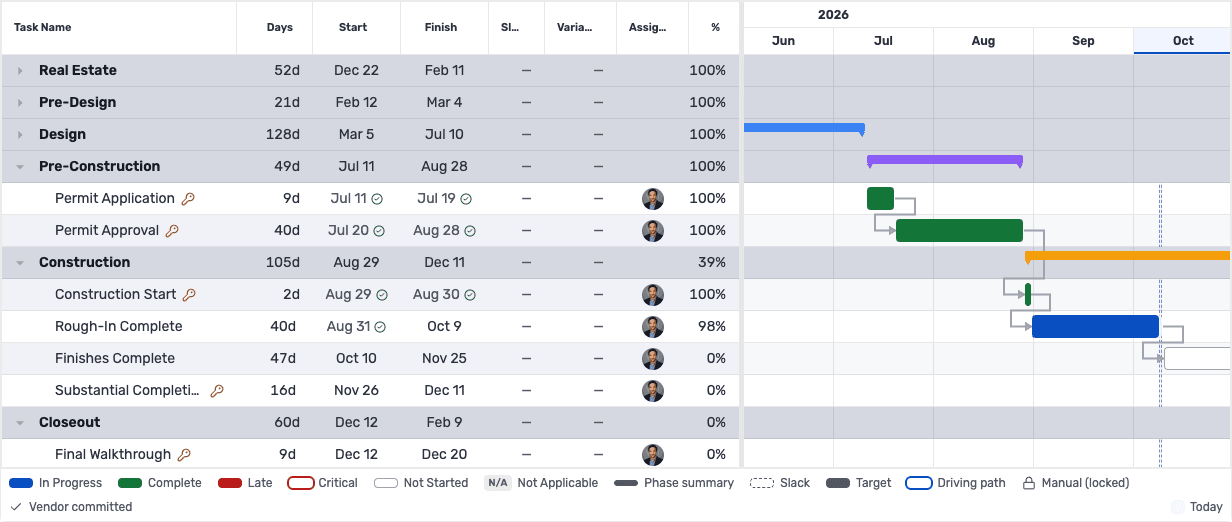
With the date and the owners in place, lay out the schedule from lease execution to grand opening. Most retailers run against a similar spine of milestones whatever the brand calls them: lease, design and construction documents, permit, landlord delivery, bid and award, construction start, rough-in and inspections, fixtures and equipment, IT, certificate of occupancy, punch, training, and opening. A standard schedule for each store format saves rebuilding that spine for every site.
Permit review deserves extra time. Turnaround runs from a few weeks in many suburban jurisdictions to two or three months in the largest coastal cities, and they change from year to year. Restaurant Business reported in 2023 that permitting had delayed Portillo's new openings in 2022 by six to eight weeks, and the company opened five restaurants against a plan of at least seven.
Many retailer playbooks expect punch to finish about two weeks before opening, which gives the operations team a clean store to train in. A schedule with no slack between the certificate of occupancy and opening day leaves training to absorb any inspection that fails.
In RolloutIQ™, an admin keeps a schedule template for each store program, and applying it to a new project lays out every phase, deliverable, and dependency forward from a start date. The planned opening comes from the schedule itself and sits next to the target opening on the project overview. The internal team gets a notification the first time a change pushes the plan past the target.
The last 60 days and the handoff to operations
The final two months are where construction and operations overlap. Fixtures arrive while drywall is still finishing, and the hiring plan assumes a training date that depends on a certificate of occupancy nobody on the team controls. A short weekly review, run from the schedule and organized by owner, catches most of these conflicts while there is still time to resequence.
Teams often skip the handoff, so before the project closes, operations should receive the open punch items with their owners, the warranty contacts and expiration dates for major equipment, the as-built drawings, and the permit and inspection records the facilities team will need later. Because post-opening punch commonly runs for weeks, the list needs an owner on the operations side and a date by which construction will close it.
Reducing Delays in New Store Openings goes deeper on why openings run late. When the question shifts from one store to a program of them, The Retail Rollout Timeline and the new location openings page pick up from here.
Sources
The figures and lease language cited in this article come from the following sources.
- Cox, Castle & Nicholson, Top 5 Considerations for Retail Landlords When Negotiating Letters of Intent (2021) - https://www.coxcastle.com/publication-top-5-considerations-for-retail-landlords-when-negotiating-letters-of-intent
- Texas Roadhouse, Inc., Annual Report on Form 10-K for fiscal 2017 - https://www.sec.gov/Archives/edgar/data/0001289460/000155837018001026/txrh-20171226x10k.htm
- The Cheesecake Factory Incorporated, Annual Report on Form 10-K for fiscal 2025 - https://www.sec.gov/Archives/edgar/data/887596/000110465926018643/cake-20251230x10k.htm
- Restaurant Business, reporting on permitting delays to restaurant growth plans (January 25, 2023) - https://www.restaurantbusinessonline.com/operations/restaurants-growth-plans-get-stuck-red-tape
The Rollout
The Rollout, in your inbox
A founder's read on retail and multi-site store development. What the latest news means for your pipeline, and what we are building, every couple of weeks.

Written by
Nariman Shariat
Founder, RolloutIQ
Nariman has spent about 20 years opening stores, in the seat between the landlord, the architect, and the general contractor, across some of the largest retail and workplace fleets in the country. Along the way he built the internal platform that ran store development across a fleet, then rebuilt the same idea company after company. He founded RolloutIQ to give multi-site development teams the single source of truth he kept having to build by hand, and writes here about the work of opening and remodeling stores at scale.
More about NarimanKeep Reading
Related Articles
Continue exploring best practices for store development and construction management.

Reducing Delays in New Store Openings: A Practical Guide
Every delayed store opening costs money in lost revenue, extended rent obligations, and team morale. Here are the practical strategies that top operators use to hit their dates.

The Retail Rollout Timeline: From Lease to Grand Opening
From lease execution to grand opening, a store project moves through a predictable set of milestones. Here is the retail rollout timeline by phase and format, and where the time actually goes.
The Pre-Construction Checklist Every Retail Buildout Needs
Most construction delays trace back to gaps in pre-construction. Here is a checklist that closes those gaps before you mobilize a single trade.
Ready to Build Smarter?
See how RolloutIQ™ can streamline your retail and multi-site rollout program. Book a personalized demo with our team.